9 DIY Ways to Work With & Style Vaulted Ceilings
Written by Milan Jara on 6th Aug 2025
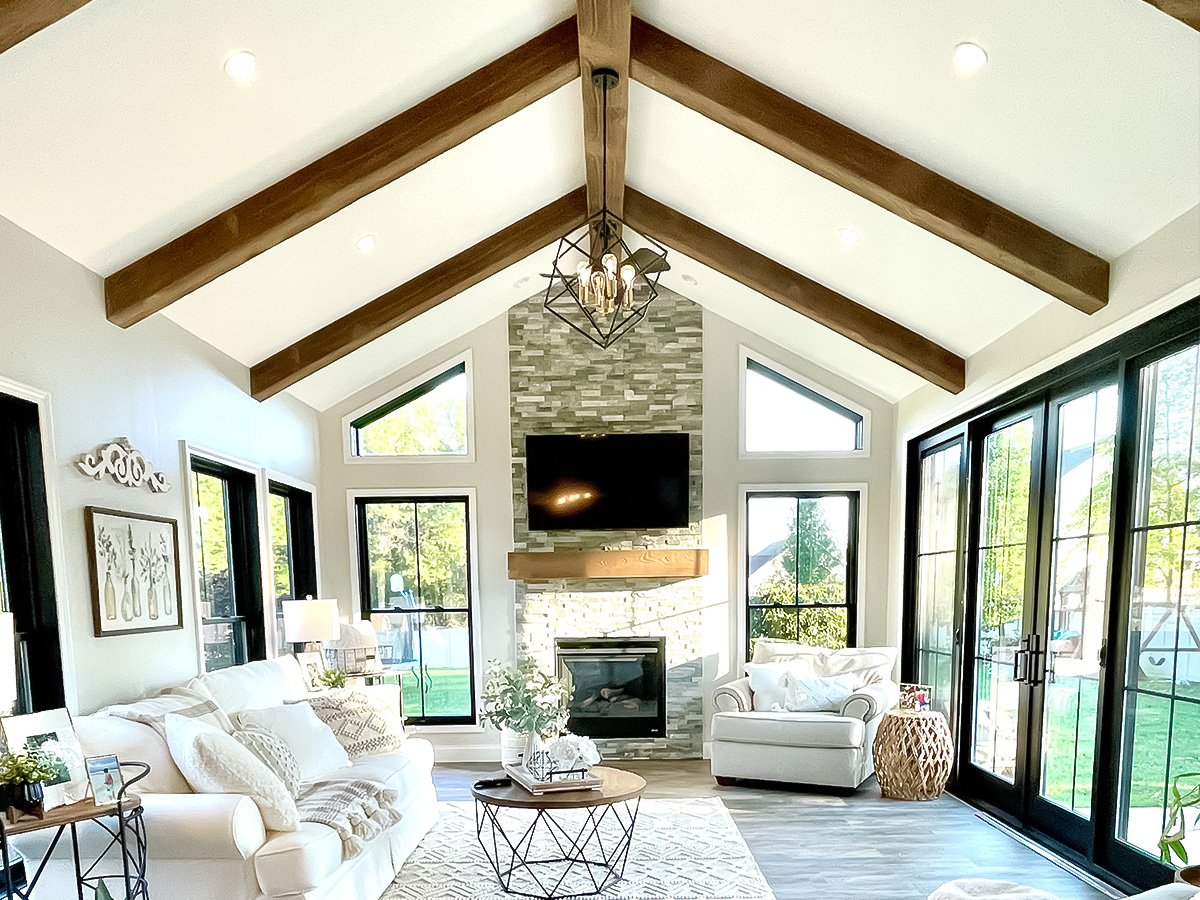
Vaulted ceilings give you height and an open-air space you can use to add personality to your space like faux-wood beams for a rustic feel, artwork for a way to bring attention upwards and give something interesting for guests to explore, and chandeliers or lighting to fill the void with ambient light and pass it to the room below.
The goal is to keep it intentional so you make the space feel part of the room vs. an open void. If the goal is to draw attention away like a large A-frame cabin, you can level it off with horizontal rafters to create a horizon line keeping the focus on the space below.
Below are nine ways to work with vaulted ceilings whether you’re looking for a DIY project over a weekend, or are a contractor and you're coming up with ideas for a client. Best of all, each one builds on the next. It starts with knowing what the elements can do for the space and the types of vaulted ceilings.
Three Types of Vaulted Ceilings
A vaulted ceiling is any ceiling that slopes or arches up instead of sitting flat. It rises higher than the standard 8 - 10 foot ceiling and can be symmetrical, curved, or sloped on one side.
- Cathedral ceilings follow the roofline with two equal slopes that meet at a center ridge. They are symmetrical and have a peak and end at the wall’s height.
- An A-frame follows a steep, A-shaped roof where the ceiling slopes run nearly to the floor. Because there is very little vertical wall space, the ceiling itself becomes the room's primary visual surface, making structural details like faux beams, rafters, large chandeliers, and hanging lights important for controlling the space.
- A partial or half vault ceiling slopes on one section or side of the ceiling before meeting a flat area. These are built into space to add height without taking over the room while leaving a natural break line for a change of color or material.
Knowing how to work with the slope will help you select which of the tips works best for your space. The ideas can be used as-is, or mixed-and-matched to come up with something brand new. Half-vaults and cathedral style ceilings could do well with trusses to define the slope and bring eyes along. This elongates the space vs. letting it feel cavernous above.
Chandeliers can build a focal point and fill the space comfortably, but don't always work with half-vaults because the assymetry and imbalanced light being projected can throw it off, but recessed lighting can build ambient light into the space below with all type, and help offset the imbalance of a chandelier.
Here’s 9 ways to mix, match, and work with vaulted ceilings.
1. Run Faux Wood Beams Up the Slope
The fastest and easiest way to finish a vaulted ceiling is to run faux-wood beams up the slope. By adding the beams to follow the slopes, you bring attention to the height of the space so it feels more airy. This makes it easier to add focal pieces like chandeliers, bring attention to stained glass windows you want to highlight, and art if you add frescos, wall sculptures, or other accent pieces later on.
Faux-wood beams are better than authentic wood as they are molded from real timber but cast in lightweight polyurethane so they do not require additional structural support from the ceiling. They are hollow, so they fit over wood blocks fastened to the slope and attach with adhesive and screws making them easy-to-install.
Best of all the faux-wood beams are less expensive than authentic wood and are easier to maintain as the materials are naturally moisture resistant and do not need special oils or cleaning supplies like real wood beams.
2. Frame the Peak with a Faux Truss or Beam Grid

A truss pulls the eye straight to the peak and some shapes like a queen style gives a tall room a clear focal point while making the space feel less expansive. A grid of them adds rhythm across a wide ceiling by filling the space where a single beam would look lost.
And the truss system can start higher up on the wall vs. being anchored to the floor allowing for a horizon line to separate the ceiling from the room using paint, molding, or other materials at the base. This is perfect if you want a nice architectural detail in the upper portion, but have a room that feels less overwhelming and cavernous below.
Faux-wood truss systems look perfect with cathedral ceilings, they pair perfectly with ridge beams, and can be done with repeating king-posts down the room in larger areas. Just make sure to keep the spacing even so it looks built in, not added on.
3. Light It in Layers
Vaulted ceilings need multiple layers of lighting to fill the space inside the vault and the area below. Only one layer of lighting creates a cave effect since the shape of the vault absorbs light, and two can create an imbalance. You’ll need three layers for a full and comfortable space including ambient, task, and accent lighting.
- Ambient lighting can be a statement fixture at the peak that helps to anchor the height of the space and fill the top area. This can be a chandelier or pendant on a sloped-ceiling adapter.
- Recessed or track lighting on the slope helps to bring ambient light into the area of the vault and below while preventing the angles from going dark. This can work as task lighting, especially if there are pendant lights placed strategically over spaces like counters, tables, and work areas.
- Accent lights placed down low and along the slopes add warmth and show off the space. These can be wall sconces and LED strips and they help to ensure everything is filled with light to make sure nothing feels empty.
Start at the peak with a chandelier or pendant on a sloped-ceiling adapter, because that's your main ambient light. The goal is to throw a wide, warm glow to open up the whole top half of the room so the peak never feels dark or far away.
Next add recessed or track lighting along the slope to keep the angled surfaces bright. This stops the ceiling from turning into one big shadow. It is especially true for half-valuted ceilings with windows that allow natural light in, or when a tall room is lit only from below.
Finish the layers with accent lights using sconces and LED strips along the beams or the walls to bring light back to eye level, and that's what makes a big room feel warm and lived-in at night instead of vast and echoey.
4. Choose the Right Ceiling Fan and Set It Correctly
To get the best performance from your fan, position the blades so they can move the air you actually feel. In a standard room, you'd want to use an extended downrod to drop the blades into the optimal airflow zone of 7 to 9 feet from the floor. But that doesn't work for high-vaulted ceilings.
If you're dealing with a soaring cathedral or A-frame ceiling that climbs 13 feet or higher, dropping a fan that low will look awkward and cut the room in half. In these tall, vaulted spaces, keep the fan higher, around 10 to 12 feet from the floor, and scale up to a larger 60 to 72 inch blade span with a high-CFM motor so the breeze still reaches the living space below.
The rotation of the fan blades also matters. In summer, a fan needs a clear pocket of air above it to pull from, and mounting it too high or too tight to a steep slope chokes its intake. During the summer months you’ll want to run it counterclockwise so it pushes cool air down.
In winter the physics flips and warm air collects at the highest point of a tall room, so running the fan clockwise on low gently pushes that trapped heat back down and circulates it better. This helps fix the cold floor problem rooms with vaulted ceilings normally have.
For super high ceilings, you need to be cautious of the height. If you place the fan too low in a 15-foot room, it sits completely below the warm air pocket which eliminates the purpose of bringing the trapped heat back into the living space.
5. Treat the Ceiling Surface as a Finish
Covering a massive, blank drywall ceiling makes the space feel complete because the open area becomes pleasant to look at as there will be textures, details, and colors vs. a flat, open blank canvas that makes you feel tiny in a cavernous room.
Faux-wood beams, boards, or ceiling planks placed either straight to add leading lines, or in patterns like herringbone to add movement and direction, turn the vast overhead area into an architectural feature that elongates the room. By drawing the eye upward along with the textures from the grain of the wood, they emphasize the room's height and make a narrow space feel significantly longer and more cohesive.
Wood slat panels do double-duty by introducing rich, physical texture while dramatically dampening sound. The physical gaps between the slats allow sound waves to pass through and get trapped by the heavy felt backing. This helps eliminate the annoying echo and "ring" common in high-ceilinged rooms.
Decorative ceiling tiles transform a plain ceiling into an elegant, custom showpiece through repeated patterns, the shine of metals, and the colors on PVC or painted options. The tiles help break up the overwhelming emptiness of a massive ceiling and the soaring height.
6. Tame the Echo in Big Vaulted Rooms
Big rooms with hard surfaces and high ceilings echo, because the same height that looks so good also gives sound more room to bounce between drywall, windows, and floor before it dies down. This is why voices ring and TV audio smears in a vaulted great room.
One way to control this is to add soft, sound-absorbing materials or acoustic ceiling tiles on the ceiling to help do most of the work. Next combine thicker materials throughout the space including rugs, upholstered seating, and drapes to help at floor level.
The more glass and plaster you have, the more soft surface you need. You can even try a sound dampening art piece suspended up high, this helps block the soundwaves as they pass through the vault and provides a fill the open air above you.
7. Put Windows Where the Wall Is Tallest
The tall walls and roof of a vault are the best spot for light that a flat ceiling cannot get. A flat ceiling would need to cut into the roof and have a skylight type window, which looks awkward on horizontal surfaces. Vaulted ceilings allow beams of light to come through to the wall creating a visual effect that is pleasing, and allow natural light to fill parts of the space in its path.
There’s a few types of windows and ways to place them. Clerestory windows are perfect near the peak, tall narrow windows up the wall, and skylights work where wall space is tight.
The Department of Energy daylighting guide notes that north-facing glass gives even light with little glare, while south-facing glass brings in the most winter sun. North-facing clerestory windows give diffuse daylight most of the day. For a skylight, the DOE rule of thumb is no more than about 5 percent of the floor area in rooms with many windows, and up to 15 percent in rooms with few.
8. Decorate the Tall Walls to Match the Scale
Tall walls need big decor to help prevent them from feeling empty and disconnected from the furniture below. One way to start is to give the wall one anchor scaled to its full height, then build around it. A floor-to-ceiling fireplace surrounded in stone veneer or painted brick carries the eye all the way up the way.
Another option is a single oversized piece of art or a tall vertical gallery fills the zone above the sofa line that standard frames never reach. Full-length drapes hung near the ceiling, a large woven wall hanging, or shelving that climbs the wall all do the same job.
The goal is to connect the height of the walls, especially on half-valuted ceilings to the furniture at the bottom of the room.
9. Finish the Edges with Trim and the Right Paint
A bare joint where the wall meets a sloped ceiling looks unfinished, and standard crown molding will not sit flush on an angle. Crown molding that is cut to match the slope fixes this issue. Then it is finishing it off with the right color paint. When everything is aligned and connected visually, there’s no more awkward joints so the space feels more calm and relaxing vs. open and off.
Crown molding may seem intimidating at first, but it is actually simple to install and we have this post with examples of how crown molding works specifically with vaulted ceilings.
Installation is easy.
- Cut the molding to the slope angle.
- Glue or nail into place.
- Add beam end caps for a clean finish.
- Paint them to match, blend, or contrast.
- Crisp whites and light neutrals keep the space feeling open and airy.
- Warm neutrals take the chill out of a massive room and make it cozier.
If you have a towering ceiling that feels a bit too empty, a dark paint color can visually bring it down for a more intimate and comfortable feel. Just save those moody, dark tones for partial vaults so a full cathedral ceiling doesn't end up feeling like a cave.
Fun fact: The color of the ceiling makes it feel light and open, or snug and cozy.
Researchers at Johannes Gutenberg University Mainz found people judge lighter, brighter ceilings as higher than darker ones in otherwise identical rooms, and related color research shows darker surfaces feel closer to the eye, pulling attention down out of the empty overhead space and into the room where you live. That's why a white ceiling opens a vault up, and a charcoal one makes the same room feel snug.
A vaulted ceiling becomes a piece of the room and is comfortable when you treat the height as a feature. Faux-wood beams can become a truss to give some structure to boring flat walls, proper lighting like a chandelier or a hanging art pieces helps the space to not feel so empty, and a combination of windows and wall decor helps to balance the space overhead and give your eyes something to look at.