Ways to Use Tin Ceiling Tiles in Bathrooms
Written by Milan Jara on 5th Jul 2022
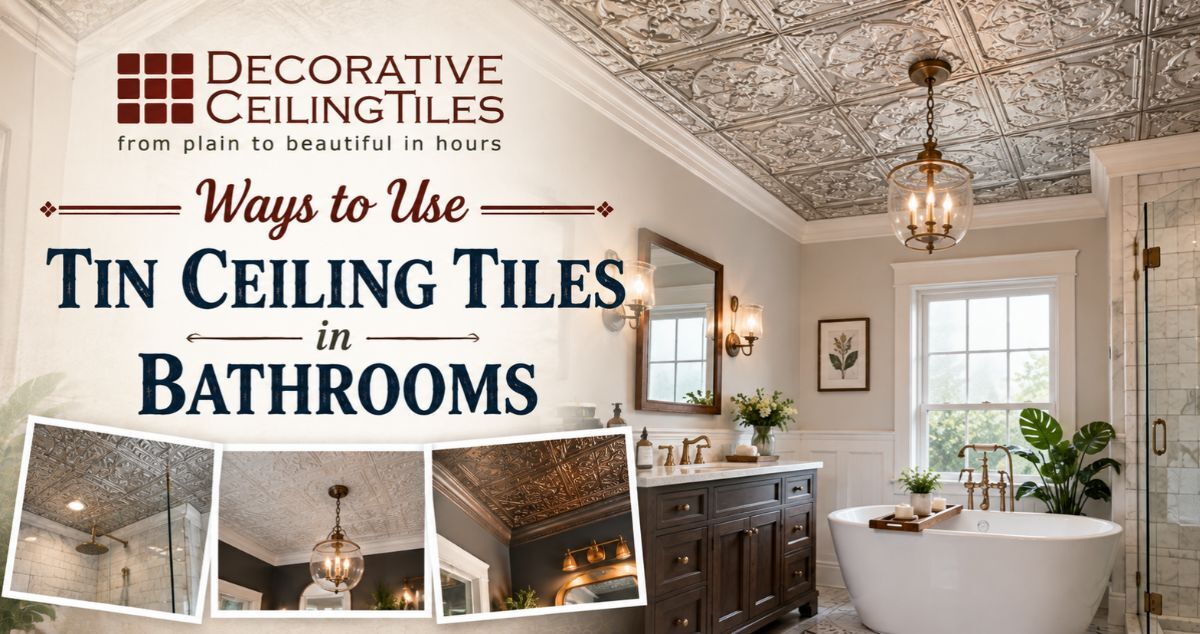
Tin ceiling tiles give you a durable and easy-to-clean surface for your bathroom making them the ideal alternative to paint that chips, stains, and types of untreated drywall that can discolor. And unlike wood that warps or other materials, tin ceilings in bathrooms stand up to steamy spaces as they are normally treated with protective finishes that help resist condensation, prevent rust, mold and mildew.
If you’re curious why we keep saying tiles, today's tin ceilings are rows of tiles that blend seamlessly so it can be hard to determine if it is a single sheet or individual tiles. Solid sheet tin ceilings stopped being popular around the mid-to-late 1800's. You can learn about the history of tin ceilings here.
If you love the look of tin but want a more budget-friendly or low-maintenance option, faux-tin ceiling tiles made from PVC give you the same decorative effect, including metallic finishes, at a fraction of the price. Below you’ll find some of the reasons why home- and business-owners go with tin ceilings for their bathrooms, and then some design inspiration and recommendations to help you decide which style and effect is right for yours.
Why Tin Ceiling Tiles Work in Bathrooms
Aside from the elegant 5-star hotel look and vintage charm, there are practical reasons for having tin ceilings in your bathroom.
- Reflective surfaces bounce light and help spaces to feel larger, taller, and wider making the room feel more comfortable.
- More light in the space means it is easier to do things like apply makeup or skin creams, see details when cleaning, and catch any stains or missed spots when freshening up before you leave the bathroom.
- There are hundreds of styles and finishes including patterns that can be customized so they match every room aesthetic from modern to Victorian, art deco and art nouveau, farmhouse, and mid-century modern.
- Paint can stain, peel, and discolor, but tin will last the test of time.
- Tin ceilings are normally treated so they don’t rust or degrade quickly from steam, splashes, and the moisture that lingers in the air.
- Tin is naturally non-porous, so it is less likely to harbor mold and mildew like porous drywall, popcorn ceilings, and other surfaces, especially in wet spaces. It will also repel smells making it perfect for heavy-usage bathrooms in hotels, country clubs, restaurants, and offices.
If you’re ready to make your washroom look like new, and without a full renovation, here’s some ideas for using tin ceiling tiles in your bathroom.
Cover the Entire Bathroom Ceiling for a Focal Point
For small spaces like a bathroom, drawing the eye upward to the ceiling can help make the room feel larger. It is an optical illusion interior designers use with floor to ceiling curtains, vertical stripes on the walls, and sometimes ceiling tiles. The patterns, reflected light, and colors bring eyes up as it is an unexpected but pleasant surprise.
A decorative ceiling creates a focal point above eye level, encouraging the eye to travel vertically rather than focusing only on the room's floor area or width. This can make the walls feel taller and give a compact bathroom more of a feeling of height and dimension. Just be cautious of the color as darker colors can reduce the perceived height of the ceiling making the bathroom feel a bit more caved in.
The pattern of the tin ceiling in the bathroom doesn’t have to be any specific format, so it can complement existing finishes and wall decor. The goal is to have the decorative element to bring eyes up instead of down and across.
If there are patterned floor tiles or a busy backsplash, go with a minimalist design and even hand painted or aged options that complement the style. An aged tin ceiling tile will look great with rustic and earthy bathrooms, and simple wreaths or leaves will not take away.
If you have a modern or mid-century bathroom, go with repeating squares and strong lines to match. Powder-coated finishes work with modern as they’re subtle. For styles like art deco, hand painted tin ceiling tiles or classic, reflective tin with strong geometric shapes can work great to complement the style.
Classic and brushed tin covering the entire ceiling helps to match silver, steel, chrome, and metal hardware in the bathroom, or to offset floral patterns and artwork on the walls. It also works perfect for industrial and some rustic bathroom aesthetics.
Pro-tip: Use the finish to influence how prominent the ceiling feels. A metallic finish emphasizes the embossed pattern and reflects more light while a painted ceiling can make the design feel more subtle.
Creating a Decorative Ceiling Accent
You don’t have to cover the entire ceiling to make an impact. Another option is to focus on a smaller section to bring attention to an area without overwhelming the room. This is perfect for large bathrooms and master baths.
Tin ceiling tiles can be installed:
- Around a central light fixture like a chandelier medallion
- Above a freestanding bathtub
- Inside a recessed ceiling
A ceiling or chandelier medallion frames your central light fixture where it connects to the ceiling. You’ll see this style in grand ballrooms, and adding it into your bathroom brings elegance and intention to a small space. It’s smaller in size compared to covering an entire ceiling, so it can be a budget-friendly alternative to adding tin ceiling work. The tiles can be set into a square around the medallion, or choose a tin ceiling medallion instead of the large square.
A decorative panel can help define one area of the bathroom. For example, placing patterned tiles above a freestanding tub makes the tub feel like the centerpiece of the bathroom as the attention is drawn to the area with the strong decor elements vs. expanding across the lines of the counters, flooring, and walls. This approach is great for budget-friendly renovations, or if you want subtler ways to bring attention to a feature without overcrowding the design.
The same can be done for a sitting or makeup area, or a handwashing island in a hotel locker room by having the tiles above this space. You’ll be able to bring the focus away from more private areas like showers and changing spaces. This is especially helpful if there is a recessed ceiling. Recessed ceilings already help rooms feel larger by drawing the eye upward, and adding tin tiles brings the person’s eyes in even more.
Tin Ceiling Tiles as Backsplash and Accent Walls
Sometimes you may not want a tin ceiling in your bathroom, but still want the reflective surfaces and textures. This is where a tin backsplash comes in to add texture to bathroom walls, and it can hold up better in humidity than wallpaper or paint.
A small installation can create a feature wall behind a vanity or bathtub, while a larger arrangement like using a molding rail to divide the upper and lower portion with tiles as either the upper or lower can create a dramatic look. The added benefit is you can create complementary or contrasting colors with the upper or lower section from the molding.
Tin looks great with virtually all hues on the upper or lower section, except when similar silvers and greys are used on the opposite section of the wall as the color of the tin will compete. With fixtures like faucets it complements, but an entire wall with tin on one half and the same color paint on the other can appear washed out and a bit too robotic.
Try using tin ceiling tiles and panels:
- Behind a bathroom vanity
- Above wainscoting for light reflection
- Below wainscotting or a molding divide to make cleaning the lower section of the walls easier than paint
- Behind a freestanding tub
- As an accent wall
- Around a mirror
- As decorative backsplash
Pay Attention to Patterns With Accent Bathroom Walls
Ornate patterns go with simple bathroom fixtures because the ceiling tiles provide the decorative detail that the rest of the room lacks. For a classic, vintage-inspired look, coordinate the tile pattern with traditional fixtures by repeating motifs or symbols, like a fleur-de-lis, or pair it with a statement light fixture. But adding more detail when there is already a lot can make the space feel crowded and busy vs. relaxing, luxurious, and spa like.
If the fixture has floral elements like an ornate wall sconce, make sure the pattern of the tiles does too if you want it to flow, or go with a minimalist design with a simple square or circle if you want the tiles to help the feature pop. For a more contemporary bathroom, look for geometric patterns and pair them with streamlined fixtures so the contrast. For vintage and rustic bathrooms, going with an aged finish works perfectly to keep the theme intact.
Pro-tip: When using them directly in water like for a shower backsplash, make sure the specific tile and finish are safe for direct water exposure. Tin is metal, so if it is not treated and water resistant, it could eventually rust.
Adding a Vintage Feel to the Space via Patterns
Tin ceiling panels were popular in the late Victorian era, so when people see them there is an automatic association with "old-timey charm" and "elegance". This is especially true if they live in an area with Victorian buildings and architecture. These associations are the reasons why they work perfect for bathrooms with clawfoot tubs, pedestal sinks, brass hardware, or decorative molding.
For vintage vibes, go with tin ceiling tiles that have floral or scrollwork designs that match the same level of ornamentation throughout the room. However, the elements do not have to remain consistent to work.
Victorian design uses wainscoting and simpler design elements from the floor up to about waist height. Then the middle area can be a rich colored paint, or heavily detailed wallpaper. From there the ceiling gets heavily ornate details that complement the walls in theme, but don’t have to match. The rooms become top heavy but balanced keeping eyes up and level vs. looking down.
For an Art Deco-inspired bathroom, look for geometric tin patterns featuring sunbursts, fans, diamonds, or stripes. These symmetrical shapes and patterns were popular in the era and can be paired with metallic finish on light fixtures and hardware. Gold and silver were especially popular colors used in the period, and these are finishes available on multiple styles of faux-tin ceiling tiles.
When choosing a tin ceiling pattern, always look at the other decorative elements already in the room. If flooring or shower tile has a strong pattern, use a simpler ceiling tile to bring balance. Or, use a bold tin ceiling to become the room’s focal point.
Pro-tip: Repeating a shape or color from another element in the bathroom helps the entire room feel put together. This could be a fluer-de-lis or flowers.
Country Clubs and Spas
These shared facilities need durable, easy-to-maintain surfaces, and they need to create a comfortable atmosphere so members will want to come back. Tin ceilings meet each of these requirements.
The ornate details feel luxurious and add a bit of sophistication. Unlike paint or standard commercial ceiling tiles, they won’t discolor or get water stained from the humidity if they're treated. And they’re easy to clean, helping to make the space feel hygienic.
Best of all, authentic tin and PVC (faux-tin) are naturally odor resistant because they are non-porous helping to make sure the locker, shower, and changing rooms always smell as good as they look.
A country club could pair a traditional embossed pattern with warm wood and brass accents to create a refined, luxurious space. Modern fitness clubs could use a geometric pattern with contemporary light fixtures to invite a clean atmosphere. Classic and shiny tin can work well with industrial vibes and metal accents mixed throughout.
One added benefit to changing and more public restrooms is that tin ceiling tiles also bring eyes upwards vs. people looking around. This helps make the space more comfortable if some of the people using the facilities are more shy. You could further bring eyes away from the lockers, showers, and changing areas by using tin behind a vanity or seating area so eyes focus there vs. private spaces.
Tin ceiling tiles add detailed patterns, texture, and additional light to bathrooms when they’re reflective vs. painted. This brings in more light to make the space feel more open and alive, and can help make it easier to clean spots you may have missed. You can cover the entire ceiling to create a focal point, use tiles as an accent to highlight one area, or add a decorative backsplash to draw attention to the vanity or a wall. Best of all there are designs that fit every type of decor style from vintage and traditional to sleek and modern.